

What is a Ghost, Even?
In an attempt to define the term, we turn to literature, history, religion, and science, among other fields of study.

It is exceptionally difficult to write about ghosts and resist using an image of the most popular (some would say stereotypical) form of ghost. You know what I am referring to. The amorphous spectre wearing a white sheet, with holes for eyes, and sometimes a mouth:
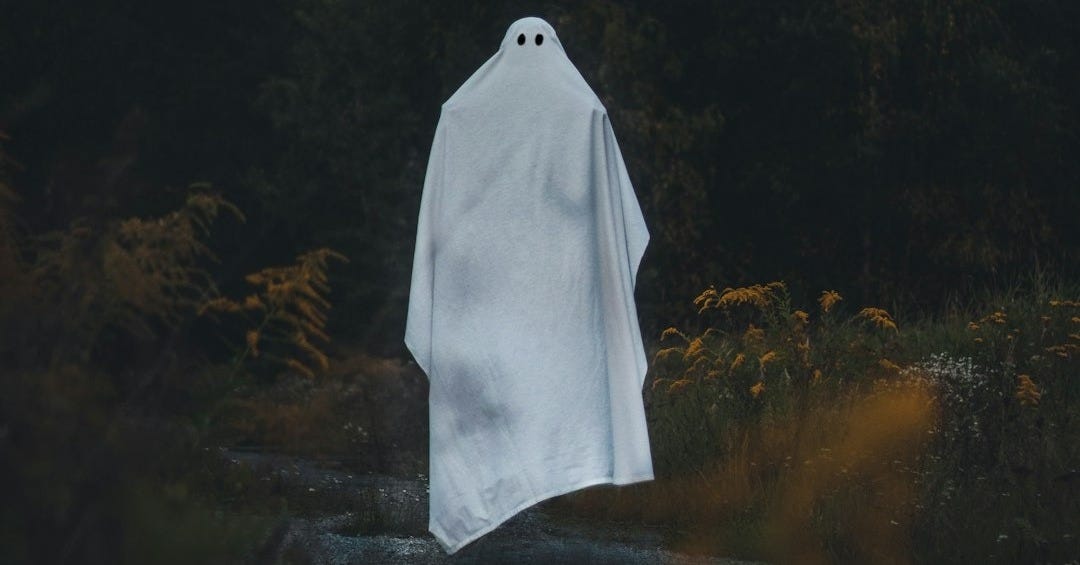
Pretty instantly recognizable.
But, importantly, what is the actual definition of a ghost? Is there a universally agreed-upon definition, not just useful for the purposes of Ghost Notes?
To attempt to answer this question, I do what most bookish reporters do: go to the library.
Getting wordy with it
“Most people still think, if they believe in ghosts, that to be haunted is to have an encounter with the actively dead,” writes Roger Clarke in 2012’s A Natural History of Ghosts: 500 Years of Hunting for Proof, one of many tomes I consulted from our local Oxfordshire library. As one of the foremost chroniclers of how people have sought to answer whether or not ghosts are, indeed, real, Clarke is one of the best sources to help us understand what meaning has been attached to these spectres over the centuries.
With the help of expertise from other fields of study, as well as cultural context from my native U.S., as well as the U.K., we begin to circle in on a general consensus of what the word actually means.
Dictionaries agree with Clarke. A ghost, per the Cambridge English Dictionary, is most often used as a noun to mean “the spirit of a dead person, sometimes represented as a pale, almost transparent image of that person that some people believe appears to people who are alive.” Cambridge also notes “ghost” can be “a memory, usually of something or someone bad,” as well as a verb for that modern colloquialism, in which one can “end a relationship with someone suddenly by stopping all communication with them.”
Ghosts were the best, almost domestic, way of proving that God existed and that atheists were wrong.
If a ghost is a present manifestation of a person who is no longer living, the interpretation of it differs depending on which period of history the ghost appears in, along with what kind of person is discussing it.
Are you there, God? It’s me, Ghost.
Clarke writes about the seventeenth century’s Joseph Glanvill, who “might reasonably be called England’s ‘Ghost-hunter General’, having published a succession of influential books on the subject of the supernatural…believed that ghosts were the best, almost domestic, way of proving that God existed and that atheists were wrong.”
The Christian-based interpretation of ghosts has figured prominently throughout British history. In The Ghost: A Cultural History, the art historian Susan Owens describes the twelfth century’s version of ghosts, called revenants. “These dead refused to stay in their tombs and insisted on climbing out and stalking back to their towns and villages, night after night, to attack the living,” she writes. “The revenants described had died ‘bad’ deaths: one of them had lived a ‘sinful’ life, while another was guilty of ‘poor conduct’; with the implication that they had died unrepentant.” In other words, revenants were created in death by their own sins.
Interestingly enough, while we live in a time in which the U.S. Christian right rewrites its ideology to serve its own purposes, these early British Christians changed their interpretation of ghosts sometime around the fifteenth century, upon their religion’s invention of purgatory, that liminal space for lost souls between heaven and hell. By then, Owens writes, those ghosts returned to earth “to ask the living to take action by organising prayers, masses and absolution for them in order to secure a speedy transfer up to heaven.” Over 200 years later, Glanvill, the “Ghost-hunter General,” concurred with the belief that if ghosts weren’t from purgatory, they were absolutely from hell.
Back off, man. I’m a scientist.
By the nineteenth century, scientists were working to determine a) whether or not ghosts were real and b) if so, what made them return to the world of the living. In 1882, the Society for Psychical Research was founded in London by members of the British upper class to pursue scholarly research in the paranormal, the first organization of its kind to exist in the world.
In Victorian England, ghost mania was in full swing. Parlors across London were crowded by members of the public nightly to be entertained by mediums, those people (often women) who claimed they could speak to the dead. Mediumship continued apace through the twentieth century, and prominent figures of the time, including the magician and escape artist Harry Houdini, spent much effort debunking mediums as frauds. The Society for Psychical Research’s committee on mediums, Clarke writes, encountered an uphill battle in their investigations. “It was quickly established that out of the hundreds then in London and the major cities, there were no candidates worthy of consideration.”
Ghost sightings were a kind of group hallucination — signaling the emergence of belief that the human brain, and an imbalance within it, was responsible for ghosts.
The Victorian period also gifted the world with its biggest contribution to the horror genre with its ghost stories. “The early stories were steeped in gothic melodrama, with a pronounced sense of madness and derangement,” Clarke writes. That idea of madness was never far away from paranormal researchers at the time. A Frenchman by the name of Charles Richet was the Nobel Prize-winning scientist for his discoveries of anaphylaxis, autoimmune and allergic responses, in addition to the presence of hydrochloric acid in the human stomach. He also coined the word “ectoplasm,” the slimy substance left behind by ghosts (and popularized decades later by the movie Ghostbusters.) Richet thought that ghost sightings were a kind of group hallucination — signaling the emergence of belief that the human brain, and an imbalance within it, was responsible for ghosts.
Amid these scholarly pursuits, another thread began to intertwine with the study of parapsychology, as these upper-class scientists encountered people from the lower classes who believed in ghosts. John Ferrier, a physician in Manchester, England, published a theory in 1813 that ghosts were the result of a person’s brain incorrectly interpreting what the person was seeing. Another Frenchman from the period, Marcel Viollet, appeared to concur, believing that “those with hereditary nervous dispositions seemed drawn to the subject of ghosts like moths to a flame, exacerbating their weak wills and damaging their weak intellects,” per Clarke. In other words, an interest in ghosts was increasingly seen as a pursuit of only the most common and lowbrow people.
As the famous British psychologist and magician Richard Wiseman wrote in Paranormality, a 2011 nonfiction work using scientific research to explain the paranormal, “They [ghosts] are simply the price we pay for having remarkable brains that can effortlessly figure out why other people behave the way they do.” He explains that humans broadly share a reluctance to accept what happens in their lives as meaningless. In this manner, the ghost becomes the means to the end, an explanation for a creaking floor or a faulty lamp.
Rich ghost, poor ghost
Britain is famously a class-obsessed society. (There are anywhere between four and seven classes within present-day Britain, depending on which survey you consult.) And, if we go back to the Christian definition of ghosts, their depiction in medieval England signaled they were the lowest of the low, class-wise. First dressed in black, but then bedecked in white once they made their way through purgatory to heaven meant “a deep-rooted connection between black-clothed ghosts and a sense of very fresh malaise, and possibly even evil,” writes Clarke.
As the middle class in the U.S. and U.K. gained size and power throughout the eighteenth and nineteenth centuries, the loudest supernatural skeptics also emerged. Underpinning this class struggle was another interpretation of the ghost: metaphor. “If you were poor, it was because you hoped for the future; and if you were aristocratic and rich, it was because you trusted in the past,” writes Clarke. The Romantic arts and literary movement happened roughly around the same time, and for those folks, per Owens the art historian, “ghosts could tell us about the most secret corners of our souls.”
The American ghost is indivisible from, as well as being defined by, the nation’s history of slavery, racism, and violence.
Hilariously enough, though, the Brits selling haunted properties in this period made sure to highlight their supernatural amenities to U.S. buyers in order to make a bigger profit. “These homes were mostly sought by gauche Americans who had extremely classist tastes,” writes the horror fiction author Grady Hendrix in the appendix of his novel How To Sell a Haunted House. “‘They like one that is an original kind, particularly one that has any historical association,’ [said a real estate agent in a 1907 Daily Mirror story.] ‘I believe that if you could convince one of these Americans that a certain house was haunted by a shade of Queen Elizabeth, he would pay any price you demanded for it.’”
America has its own brand of ghost, the result of what the late author Toni Morrison described in the country’s literature as the “thematics of innocence coupled with an obsession with figurations of death and hell.” In Haunted States: An American Gothic Guidebook, literature professor Miranda Corcoran writes that the U.S. ghosts are “wispy forms who speak to historical transgressions and abuses whose memories we might prefer to bury deep beneath its foundations.” In other words, the American ghost is indivisible from, as well as being defined by, the nation’s history of slavery, racism, and violence.
Get in, loser. We’re going ghosthunting.
With the advent of the horror film, and the proliferation of ghosthunting shows on TV, what a ghost means in the twentieth and twenty-first centuries is split between two camps. In the world of entertainment, “ghost films worry [about] the boundary between our own private universe and the objectively ‘real’ world of consensus reality,” write Kim Newman and James Marriott in The Definitive Guide To Horror Movies. The continued box office success of supernatural flicks – and the appearance of elevated horror fare such as The Substance, Weapons, and Sinners at awards shows – is a bright spot for Hollywood in the post-Covid, mass streaming era. Ghosts exist for a range of reasons in horror movies – more to come here in a future post – but mainly as a contemplation on the things humans have difficulty understanding.
Ghosts make their appearance on the small screen, Clarke says, because they’re good money: “The long-running British TV show Most Haunted generated a tidy income for its producers simply by popularizing the ghost hunt and making it financially lucrative.” As for the U.S., the author Hendrix draws a line between economic precarity and haunted homes. “Reality ghost hunting shows slowly snowballed in popularity until 2007 when the subprime mortgage crisis sparked the biggest recession since the Great Depression, at which point they exploded,” he writes. “More than 70 paranormal reality shows premiered during that decade.” The home, Hendrix says, represents financial security, especially to the first-time buyer. But like holding an underwater mortgage, owning a haunted home can leave you bankrupt – or worse.
But what does it mean?
With all of that said, how do we settle on a definition of a ghost that is appropriate for 2026? I believe the research here shows that a ghost is defined by a set of characteristics. But those characteristics are not of the deceased. All definitions, past and present, have the requirement that the ghost is a manifestation of someone no longer living.
A new set of criteria relies upon the person or people witnessing the ghost: What is the dominant religion of the place and era in which the ghost was spotted? Did the witness(es) practice that religion, or another? What was their class or their socioeconomic status? What does the latest scientific research available from the time of the haunting say on the matter?
Although ghosts have long made their pale and diaphanous appearances in black and white, we humans should consider all of our own shades of gray to truly understand what is haunting us — and why.